
Masseter Botox: Jaw Slimming and Clenching Relief Explained
Masseter Botox relaxes the jaw muscle to ease clenching and soften a square jaw. See results, risks, jowl concerns and Canadian costs.
12 min read
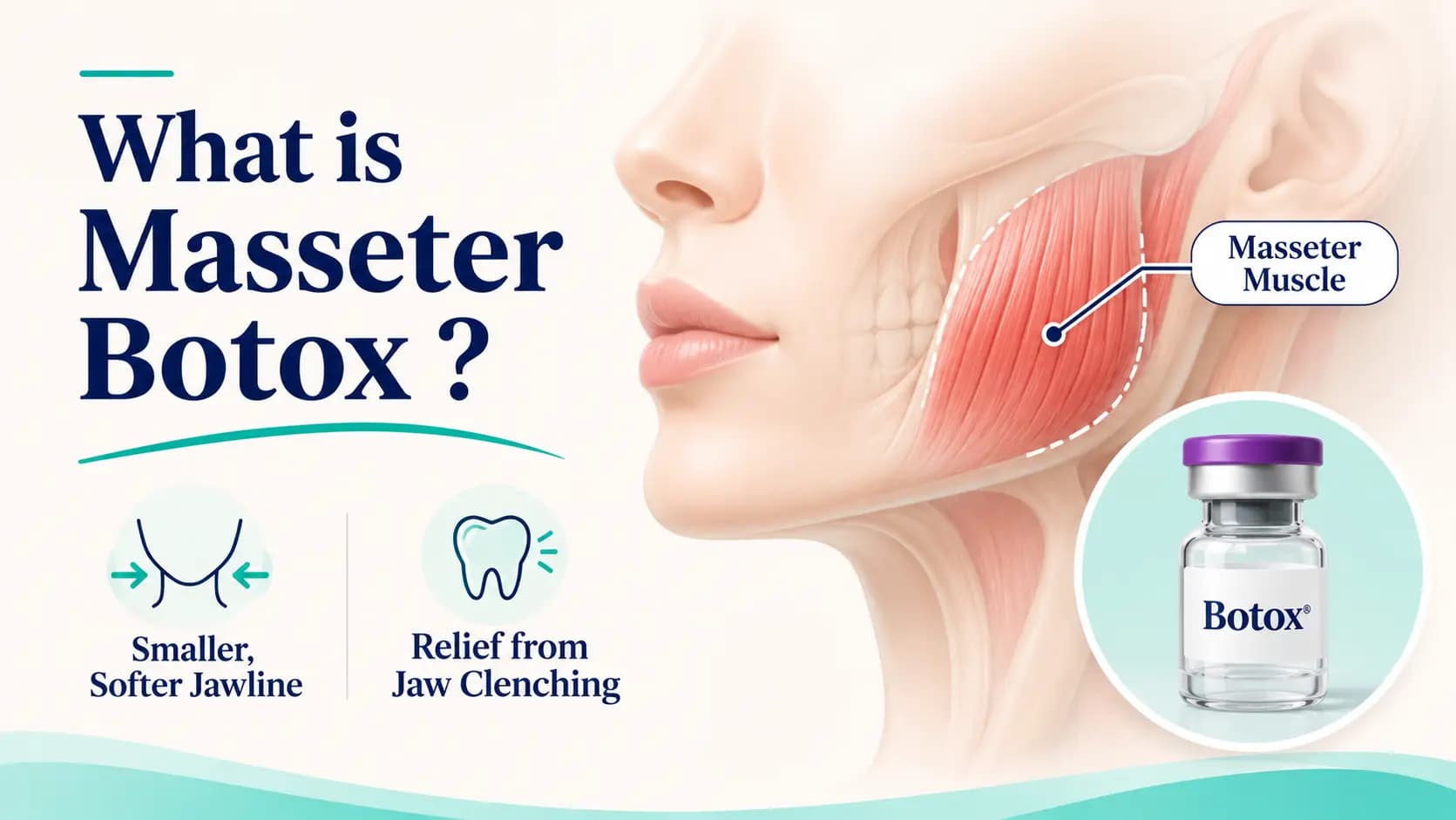
Masseter Botox is a neuromodulator injection into the large chewing muscles at the back of your jaw.
It relaxes those muscles, which may ease clenching, grinding and jaw tension. Over several weeks, it can also make a wide lower face look softer and slimmer.
Medically reviewed by Lynda Quesnel, NP, on November 16, 2026.
TL;DR
What it treats: an overworked masseter muscle, the main cause of clenching and a square-looking jaw.
Two goals: medical relief (clenching, grinding, TMJ discomfort) and cosmetic softening (jaw slimming).
Timing: relief often starts within 1 to 2 weeks. Visible slimming tends to take longer.
How long it lasts: about 3 to 4 months on average, so it isn’t permanent.
Biggest worries: smile changes and jowls. Both relate to dosing, placement and your anatomy, which is why the consultation matters.
Have you ever woken up with a jaw that feels like it ran a marathon overnight?
Most people don’t connect that ache to their face shape. But the same muscle is often behind both.
At Allure Medical Aesthetics, a nurse practitioner-owned clinic in Southampton since 2016, jaw questions usually start the same way. Someone comes in about a sore jaw or worn teeth, then mentions their face looks wider than it used to.
Here’s what’s really going on, and what masseter Botox can and can’t do.
What Is Masseter Botox?
Masseter Botox is a small series of injections that temporarily weakens the masseter muscle so it can’t clench as hard.
It uses the same type of wrinkle-relaxing neuromodulator used for frown lines. The difference is the target: a thick chewing muscle instead of a thin facial one.
Where Is the Masseter Muscle?
The masseter runs from your cheekbone down to the corner of your jaw, and it’s one of the strongest muscles in your body for its size.
You can feel it yourself:
Place your fingertips just in front of your earlobes, slightly lower.
Clench your teeth.
Feel the firm bulge pop out under your fingers.
That bulge is your masseter at work.
How Does Masseter Botox Work?
It blocks the nerve signal that tells the muscle to contract, so the muscle relaxes and, with time, may shrink a little from reduced use.
→ Less signal = less clenching force
→ Less clenching over weeks = a smaller, softer muscle
→ Smaller muscle = a slimmer-looking lower face
Think of it like a gym membership in reverse. Skip the workouts long enough and the muscle downsizes.
Why People Get Masseter Botox: Clenching, Slimming or Both
People usually come for one of two reasons, medical relief or a softer jawline, and many end up with a bit of both.
Masseter Botox for Jaw Clenching, Teeth Grinding and TMJ
For clenching and grinding (bruxism), masseter Botox may reduce the force of the bite and ease the pain that comes with it.
Common signs that bring people in:
Waking with a sore or tired jaw
Tension headaches near the temples
Worn, chipped or sensitive teeth
A cracked or chewed-through night guard
Jaw clicking or tightness linked to TMJ (temporomandibular joint) discomfort
Allure lists jaw pain, clenching and TMJ under its medical Botox for jaw clenching and TMJ services.
It doesn’t fix the cause of stress or a bite problem. It eases how hard the muscle fights back.
Botox Jaw Slimming for a Wide or Square Lower Face
Botox jaw slimming targets an enlarged masseter (masseter hypertrophy) that makes the lower face look boxy.
This tends to suit people whose jaw width comes from muscle, not bone or fat. Botox for a square jaw softens the angle gradually, so it doesn’t look like overnight change.
In Canada, using a neuromodulator purely for jaw slimming is generally considered an off-label use. Your clinician should explain what that means before treatment.
When It’s Both
Many clenchers also have a wide jaw, because years of grinding build up the muscle like any workout would.
A pattern our team often notices in consultations: people asking about jaw slimming are surprised to learn they clench at night. A partner or dentist usually spotted it first.
Who Is a Good Candidate for Masseter Botox?
Good candidates usually have a strong, active masseter, realistic expectations, and no medical reason to avoid neuromodulators.
Signs You May Benefit
Question | If yes, it may point to |
|---|---|
Does your jaw bulge when you clench? | An active, enlarged masseter |
Do you wake with jaw pain or headaches? | Night-time clenching |
Has your dentist mentioned tooth wear? | Grinding (bruxism) |
Is your lower face wider than your cheeks? | Possible masseter hypertrophy |
Is the width soft, not bony? | Muscle may be the main factor |
Treat this as a starting point, not a diagnosis.
Masseter Botox for Men
Masseter Botox for men is often about clenching relief, with a careful approach so the jaw keeps a strong, masculine shape.
Men tend to have larger masseters. That can mean a different plan, and a conversation about how much softening actually looks right.
Masseter Botox on a Round Face: Will It Help?
It usually helps less on a round face, because roundness often comes from fat, cheeks or bone rather than muscle.
If your jaw doesn’t bulge when you clench, slimming results may be minimal. Other options may fit better.
Who Should Wait or Avoid It
Some people should hold off, and a clinician will screen for this first.
Pregnant or breastfeeding
Neuromuscular conditions
Certain medications that interact with neuromodulators
Infection or active skin issues in the area
Noticeable skin laxity or early jowling, which needs extra caution
Masseter Botox vs Other Options
Masseter Botox is one of several tools, and the right one depends on whether your goal is protection, relief or shape.
Option | What it does | Best discussed if |
|---|---|---|
Night guard | Protects teeth from grinding | Tooth wear is the main concern |
Masseter Botox | Reduces clenching force and muscle bulk | Pain, tension or jaw width bothers you |
Chin or jawline filler | Adds structure and definition | You want balance, not slimming |
Jaw massage or stretching | May ease tension short term | Symptoms are mild |
Stress or sleep management | Targets common triggers | Clenching flares with stress |
Masseter Botox vs a Night Guard
A night guard protects your teeth. Masseter Botox reduces the force behind the grinding.
They often work well together. Many people keep their guard and add Botox when the pain or tension doesn’t settle.
If facial balance is part of your goal, our page on dermal fillers in Southampton explains how structure differs from slimming.
How Many Units for Masseter Botox?
There’s no single number. Your injector decides the dose after feeling your muscle and hearing your goals.
What usually shapes it:
Muscle size and strength: bigger muscles may need more.
Your goal: clenching relief and slimming may be planned differently.
Symmetry: one side is often stronger, so sides can differ.
Product: units aren’t interchangeable between brands.
Your history: first sessions are often more conservative.
Be cautious of online “magic numbers.” A dose that suits one face can be too much for another.
“Pro tip: Clench and unclench in front of a mirror before your consultation, and note which side bulges more so you can point it out.”
What Happens During a Masseter Botox Appointment
Masseter Botox is a quick in-clinic treatment, often 15 to 30 minutes, with no downtime for most people.
Step | What happens |
|---|---|
1. Health review | Medications, conditions and past treatments |
2. Assessment | You clench so the muscle can be mapped |
3. Planning | Goals, dose and expectations agreed |
4. Injection | A few small injections into each masseter |
5. Wrap-up | Aftercare tips and follow-up timing |
Does Masseter Botox Hurt?
Most people describe a quick pinch and some pressure, and it’s usually over within minutes.
The masseter is a thick muscle, so you may feel a deeper ache briefly. Tenderness afterward tends to be mild.
Results Timeline: When Masseter Botox Works and How Long It Lasts
Clenching relief often comes first, within 1 to 2 weeks, while visible slimming builds over the following weeks.
Time after treatment | What’s typical |
|---|---|
Days 1 to 3 | Little change; mild tenderness possible |
Weeks 1 to 2 | Clenching force and tension may ease |
Weeks 4 to 8 | Gradual softening of the jaw may appear |
Around 3 to 4 months | Effects start wearing off |
How Long Does Masseter Botox Last?
Relief lasts about 3 to 4 months on average, and repeat treatments help maintain results.
Some people notice slimming lasts a bit longer than the clenching relief, since a muscle takes time to rebuild.
Is Masseter Botox Permanent?
No. The muscle gradually regains strength as the neuromodulator wears off.
That’s a safety feature too. If you don’t love the change, it fades.
How Often Do You Need It?
Many people repeat it every few months at first, then their clinician adjusts the timing based on how long results hold.
Masseter Botox Side Effects and Risks
Most side effects are mild and short-lived, but a few uncommon ones explain the “gone wrong” stories online.
Common, Temporary Effects
Tenderness or a dull ache
Small bruises or redness
Mild headache
Chewing fatigue with tough foods like steak or gum
Masseter Botox Gone Wrong: What People Mean
Most “gone wrong” stories involve uneven results, a changed smile, or a bulge that appears while chewing.
Concern | What it is | How it’s usually reduced |
|---|---|---|
Asymmetry | One side looks fuller | Assessing each side separately |
Paradoxical bulging | A small bulge appears when clenching | Follow-up and dose adjustment |
Weak chewing | Tiredness eating chewy foods | Conservative first doses |
Smile change | A stiff or uneven smile | Careful placement away from smile muscles |
Can Masseter Botox Affect Your Smile?
Yes, rarely, if the product spreads to a nearby smile muscle (the risorius), which can make a smile look uneven for a while.
It’s temporary, but it’s also why precise placement by a trained injector matters so much.
Health Canada outlines general risks of cosmetic injections on its cosmetic injections page.
Wait, You Might Be Thinking: “Will Masseter Botox Give Me Jowls?”
For most people, no, but it can make existing skin laxity more noticeable in some faces.
Here’s why. A bulky masseter can quietly prop up the skin over the jaw. When the muscle shrinks, loose skin may show more.
Searches for masseter Botox jowls are common for a reason. The answer is a good assessment, not avoidance.
Factor | Lower concern | Higher concern |
|---|---|---|
Skin firmness | Firm, elastic skin | Noticeable laxity |
Muscle size | Clearly enlarged | Only mildly enlarged |
Dose approach | Conservative, staged | Aggressive first treatment |
A question we hear often from patients in their late 30s and 40s: “Will this age me?” A clinician should look at your skin, not just your muscle, before answering that.
Masseter Botox Aftercare
Simple aftercare helps the product stay where it was placed.
Do: stay upright for a few hours.
Do: eat softer foods if your jaw feels tired.
Avoid: rubbing or massaging the area that day.
Avoid: intense workouts, saunas and hot tubs for the rest of the day.
Avoid: chewing gum hard while it settles.
Call your clinic: if you notice trouble swallowing, speaking or breathing, or anything unusual.
Your injector may adjust these, so follow their specific advice.
How Much Does Masseter Botox Cost in Canada?
Masseter Botox cost depends on how many units you need, the product used, and whether treatment is medical or cosmetic.
Price per Unit and How Totals Add Up
Most Canadian clinics price by the unit, so your total equals the units in your plan times the per-unit price.
→ Total cost = units needed × price per unit
As a local reference point, as of November 2026 Allure lists jaw clenching treatment at $8 per unit. Cosmetic pricing is $9 per unit for Botox, or $8 per unit for Dysport or Xeomin.
So every 10 units at $8 adds $80. Your actual total depends on your dose plan.
Check current treatment pricing for up-to-date fees. Our Botox cost guide for Southampton and Saugeen Shores walks through more examples.
Is Masseter Botox Covered by Insurance in Canada?
OHIP generally doesn’t cover it, but some private insurance plans may cover treatment for TMJ disorders or clenching.
What helps:
Call your insurer and ask about TMJ or bruxism coverage.
Ask whether pre-approval is needed.
Request supporting documentation from your clinic.
Allure notes it can provide a pre-approval letter for insurers that consider TMJ treatment. Cosmetic slimming isn’t usually covered.
If cost spacing matters, some clinics offer financing options.
Choosing Who Should Do Your Masseter Botox
Choose a regulated health professional who assesses both your muscle and your skin, and plans follow-up.
What I’d look for:
Credentials: an NP, physician, RN or dentist trained in neuromodulators.
Assessment: they feel the muscle while you clench.
Honesty: they tell you if you’re not a good candidate.
Conservative start: a staged approach for first-timers.
Follow-up: a plan to check results and symmetry.
In Grey-Bruce, dentists, nurse practitioners and physicians may all offer this. At Allure, medical Botox treatments are overseen by Lynda Quesnel, NP. You can learn more in our guide to choosing a Botox clinic in Southampton.
“Pro tip: Ask your injector how they’ll keep injections away from your smile muscles, and listen for a specific answer rather than reassurance.”
Which Option Fits Your Priority?
Match your main priority to the question you bring to your consultation.
If jaw pain or headaches come first, ask about medical masseter Botox and whether it pairs with your night guard.
If a wider lower face bothers you, ask whether your width is muscle, fat or bone.
If you’re worried about jowls, ask for a skin laxity check and a conservative first dose.
If you want more definition, not slimming, ask about structural filler instead.
If cost is a concern, ask for an estimated unit range and insurance paperwork.
Frequently Asked Questions
1. What does masseter Botox do?
It relaxes the masseter chewing muscle. That may reduce clenching and grinding, and over time can soften a wide, square-looking jaw.
2. How long does masseter Botox take to work?
Clenching relief often starts within 1 to 2 weeks. Visible slimming tends to appear gradually over the following weeks.
3. Masseter Botox vs a night guard: which is better for me?
A night guard protects teeth, while Botox reduces the clenching force. Many people use both, and your clinician and dentist can help you decide.
4. Can masseter Botox help with TMJ?
It may ease muscle-related TMJ discomfort and tension. It doesn’t treat every cause of jaw joint problems, so an assessment comes first.
5. Is masseter Botox covered by OHIP?
Generally no. Some private plans may cover treatment for TMJ or clenching, so check with your insurer and ask about pre-approval.
The Bottom Line
Masseter Botox is a targeted, temporary way to calm an overworked jaw muscle. It may ease clenching and soften a square jaw, but it works best when your jaw width actually comes from muscle.
→ Clenching, tension or worn teeth = often worth discussing
→ Width from fat, bone or loose skin = usually a different plan
My recommendation is to start with a consultation. Ask about masseter Botox if your jaw bulges when you clench or you wake with jaw pain, and ask for a skin check if jowls concern you.
When you’re ready, explore medical Botox for jaw clenching or book a consultation.
This article is for education and does not replace personal medical advice. Book a consultation to discuss your health, goals and options.
- #Masseter Botox
- #Jaw Clenching
- #Jaw Slimming
- #TMJ
Ready to talk it through?
Book a consultation with our nurse practitioner–led team, or call us at 519-483-3400.
Keep reading
More from the blog
- Botox, Dysport & XeominBotox Cost in Southampton and Saugeen Shores: 2026 Price GuideBotox pricing isn't one-size-fits-all. See how per-unit costs work, what changes your total, and what to ask before booking in Southampton and Saugeen Shores.

13 min read
- Botox, Dysport & XeominHow to Choose the Best Botox Clinic in Southampton, OntarioChoosing a Botox clinic is about more than price. Learn what to check in an injector's credentials, safety standards and approach so you can book with confidence in Southampton, Ontario.

12 min read
- Lip FillerFiller Dissolver: When and How Hyaluronidase Is Used to Correct FillerA filler dissolver uses hyaluronidase to break down HA filler. See when it's used, side effects, recovery, re-filling and cost in Canada.
10 min read