
Filler Dissolver: When and How Hyaluronidase Is Used to Correct Filler
A filler dissolver uses hyaluronidase to break down HA filler. See when it's used, side effects, recovery, re-filling and cost in Canada.
10 min read
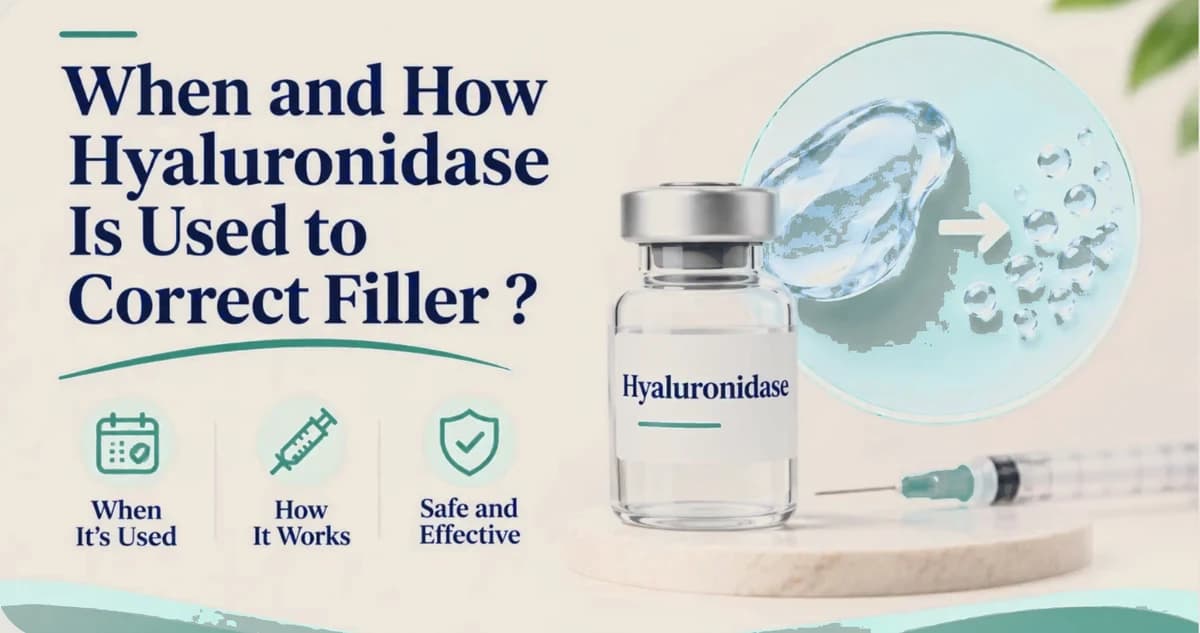
A filler dissolver is a small injection of an enzyme called hyaluronidase. It breaks down hyaluronic acid (HA) filler so your body can clear it.
Clinicians use it to soften lips, cheeks or under-eyes that look overdone or uneven, and as an urgent treatment when filler affects blood flow.
Medically reviewed by Lynda Quesnel, NP, on November 16, 2026.
TL;DR
Works on: hyaluronic acid fillers only.
Common reasons: lumps, migration, puffiness, a bluish under-eye tint, or simply wanting a fresh start.
Timing: visible change often begins within a day or two and settles over about two weeks.
Risks: usually swelling and tenderness; allergy is uncommon but possible.
Next step: if you’d like filler again, it’s usually placed after the area has fully calmed down.
Picture someone who booked lip filler a year ago, loved it for a few months, then slowly noticed a soft ridge forming above the lip line.
It isn’t dramatic. But every photo makes it more obvious.
That quiet frustration is exactly where a filler dissolver comes in.
At Allure Medical Aesthetics, a nurse practitioner-owned clinic in Southampton since 2016, filler correction questions come from people across Saugeen Shores and Owen Sound, including those treated at other clinics.
Here’s what to know before deciding.
What Is a Filler Dissolver?
A filler dissolver is a prescription treatment that uses hyaluronidase to break apart hyaluronic acid gel inside the skin.
It isn’t a cream, a massage technique or a laser. It’s an injection given by a regulated health professional.
What Is Hyaluronidase?
Hyaluronidase is an enzyme your body already produces in small amounts to manage its own hyaluronic acid.
Medical teams have used it for decades, for example to help other medications spread through tissue. In aesthetics, its main job is reversing HA filler.
How Does Hyaluronidase Break Down Filler?
It cuts the long chains that hold filler gel together into tiny fragments.
Once the gel is broken up:
The structure that held the volume collapses.
Your lymphatic system carries the fragments away.
The area gradually returns toward its pre-filler shape.
→ Hyaluronidase + HA filler = a controlled way to undo treatment
Does Filler Dissolve on Its Own?
Yes, hyaluronic acid filler breaks down naturally, but the timeline varies widely and some filler lingers longer than people expect.
Lip filler often softens within about 6 to 12 months. Deeper areas like the cheeks may hold longer.
Our guide on how long lip filler lasts covers this in detail.
Does Filler Dissolve or Migrate?
It can do both: most filler slowly breaks down, while a small amount may drift away from where it was placed.
Migration tends to show up as:
A puffy shelf above the upper lip
A blurred lip border
Fullness under the eyes that wasn’t there before
When Waiting Makes Sense, and When It Doesn’t
Situation | Waiting may be reasonable | A filler dissolver is often discussed |
|---|---|---|
Slightly fuller than planned | ✓ | |
Mild unevenness that’s fading | ✓ | |
Visible lumps months later | ✓ | |
Migration above the lip line | ✓ | |
Bluish tint under the eyes | ✓ | |
Signs of a blood flow problem | ✓ Urgently |
Which Fillers Can Be Dissolved?
Only hyaluronic acid fillers respond to hyaluronidase. Other injectables need a different approach.
Product type | Responds to a filler dissolver? | What that means |
|---|---|---|
Hyaluronic acid fillers | Yes | Most lip, under-eye and many cheek fillers |
Radiesse (calcium hydroxylapatite) | No | Gradually absorbed; can’t be reversed with the enzyme |
Sculptra (poly-L-lactic acid) | No | Works through your own collagen |
HArmonyCa (hybrid) | Partly | Only the hyaluronic acid portion breaks down |
Not sure what’s in your face? Ask the clinic that treated you for your product record before your appointment.
You can learn more about the HA products used locally on our dermal fillers in Southampton page.
When Is a Filler Dissolver Used?
A filler dissolver is used for two very different reasons: cosmetic correction and urgent medical care.
Cosmetic Correction
Common reasons people consider dissolving include:
Overfilled lips that look heavier than intended
Migration above the lip line or into nearby areas
Lumps or nodules you can feel or see
The Tyndall effect, a bluish shadow under the eyes when filler sits too close to the surface
Asymmetry between the two sides
A wish to reset after years of top-ups
Urgent Medical Use
When filler presses on or blocks a blood vessel, called vascular occlusion, hyaluronidase is given quickly to help restore circulation.
Seek same-day care if you notice any of these after filler:
Pain that’s intense or getting worse
Skin that turns pale, blue, grey or mottled
Changes in vision
This is one of the strongest reasons to choose an injector who keeps hyaluronidase on hand.
How to Tell If Your Filler May Need Attention
Question | What it may suggest |
|---|---|
Has the shape changed since it first settled? | Possible migration |
Is there a blue or grey tint under your eyes? | Possible Tyndall effect |
Do you feel firm bumps weeks or months later? | Possible lumps or nodules |
Does your face look fuller than you remember choosing? | Possible accumulation over time |
Use this as a conversation starter, not a diagnosis.
How to Dissolve Filler: What Actually Happens
Dissolving filler is a short in-clinic procedure, and the planning matters more than the injection itself.
Step | What happens | Why it matters |
|---|---|---|
1. History | Your injector asks what, where and when you were treated | Helps estimate how much enzyme is needed |
2. Allergy check | Questions about allergies, including bee or wasp stings | Screens for possible sensitivity |
3. Skin test (if used) | A tiny amount is placed to check for a reaction | Adds an extra layer of caution |
4. Plan | Full or partial dissolve is agreed | Sets realistic expectations |
5. Injection | The enzyme is placed directly into the filler | Targets only the problem area |
6. Observation | You stay briefly after treatment | Allows any reaction to be spotted |
7. Review | Follow-up once swelling settles | Confirms whether more is needed |
How to Dissolve Lip Filler
Lip filler is often dissolved in small, targeted amounts so the lips don’t look deflated afterward.
For migration above the lip line, the injector may treat only that ridge. The main body of the lip stays as it is.
Can You Dissolve Just Part of Your Filler?
Yes. Partial dissolving uses smaller amounts to soften one area rather than remove everything.
It’s less predictable than a full dissolve. Occasionally a second visit is needed to fine-tune the result.
Why At-Home “Dissolving” Methods Don’t Work
Massage, heat, vitamin creams and online kits can’t break down hyaluronic acid the way the enzyme does.
Some of these methods can bruise tissue or push filler further out of place.
Hyaluronidase is a prescription medication and belongs in a clinical setting.
“Pro tip: Write down where, when and with what product your filler was placed before your consultation, so your injector can plan the dose more precisely.”
How Fast Does a Filler Dissolver Work?
Many people see a change within 24 to 48 hours, and the final result is usually clearer after about two weeks.
After treatment | What’s typical |
|---|---|
Same day | Some softening, plus swelling from the injection |
Day 1 to 2 | Noticeable reduction in filler |
Day 3 to 7 | Swelling eases and the shape becomes easier to judge |
Around day 14 | A good point to review the result |
Older or denser filler may respond more slowly. Some areas need a second session.
Filler Dissolver Side Effects and Risks
Most effects are mild and short-lived, but an allergic reaction is possible and should be discussed before treatment.
What’s Common
Swelling at the injection site
Redness or warmth
Bruising
Tenderness or itching
A temporarily uneven look while the filler breaks down
What’s Less Common
Allergic reactions: most are local, but serious reactions are rare and need urgent care
Over-correction: the area may look flatter than before filler
Repeat sessions: some filler needs more than one round
Filler Dissolver Gone Wrong: What’s Behind Those Stories?
Most “gone wrong” experiences involve removing more volume than expected, or judging the result before swelling settles.
Hyaluronidase can also briefly affect some of the hyaluronic acid your skin makes naturally. Your body keeps producing its own, so this tends to recover over time.
Conservative dosing and staged treatment are the main ways clinicians reduce these risks.
Health Canada lists reactions reported for dermal fillers on its cosmetic injections page.
Recovery and Filler Dissolver Aftercare
Recovery is usually quick. Most people go back to work or normal routines the same day, with some swelling for a few days.
Helpful | Hold off on for a short time |
|---|---|
Cool compresses | Rubbing or massaging, unless advised |
Resting with your head slightly raised | Hot tubs, saunas and intense workouts |
Gentle cleansing | Alcohol, which can increase swelling |
Calling the clinic with any concern | Booking new filler too soon |
Get emergency help right away for hives spreading across the body, throat swelling or difficulty breathing.
When Can You Get Filler Again After Dissolving?
Many clinicians suggest waiting until swelling has fully gone, often about two weeks, before placing new filler.
That pause lets you see your true baseline. Some people decide they prefer their natural look. Others return to a smaller, more careful approach.
If you’re planning lips again, our guide to 0.5 ml vs 1 ml lip filler can help you choose a lighter amount.
“Pro tip: Save a photo of your face before you ever had filler, because it gives you and your injector a clear target when re-filling.”
How Much Does a Filler Dissolver Cost in Canada?
Cost depends on how much filler is present and how many sessions it takes. Cosmetic dissolving is generally not covered by OHIP.
What affects cost | Why |
|---|---|
Volume of filler | More gel may need more enzyme |
Area treated | Lips, under-eyes and cheeks differ |
Full vs partial dissolve | Partial plans may be done in stages |
Follow-up sessions | Some cases need more than one visit |
As a local reference point, Allure lists filler dissolving at $100 for a 30-minute visit as of November 2026. Current fees are on the treatment pricing page, and our lip filler cost guide puts it in context.
Treatment for an urgent filler complication is a medical issue. Discuss it directly with your provider.
Wait, You Might Be Thinking: “Will Dissolving Ruin My Face?”
For most people, dissolving returns the area toward how it looked before filler rather than leaving it worse.
Short-term swelling and a flatter look can feel alarming in the first few days. Giving the area about two weeks before judging it, and starting with conservative amounts, makes a big difference.
Choosing Who Should Dissolve Your Filler
Dissolving filler involves prescription medication, allergy screening and complication management, so medical training matters.
What to look for:
A regulated health professional who performs the injection
A clear allergy screen and consent process
A plan for full or partial dissolving
Follow-up built into the treatment
A non-judgmental approach if your filler was placed elsewhere
Wherever you go, you can ask to see product packaging and confirm it’s authorized for sale in Canada, as Health Canada advises.
Frequently Asked Questions
1. What is hyaluronidase made of?
Hyaluronidase is an enzyme that breaks down hyaluronic acid. In aesthetics, it’s supplied as a prescription medication and injected by a qualified health professional.
2. Can lip filler be dissolved?
Yes, if it’s a hyaluronic acid filler. Lip filler can be fully or partially dissolved to correct migration, lumps or an overfilled look.
3. Does filler actually dissolve completely?
Hyaluronic acid filler usually breaks down over time, and hyaluronidase can speed that up. Some filler may need more than one session to clear fully.
4. Filler dissolver vs waiting it out: which is better for me?
Waiting may suit minor fullness that’s already fading. Dissolving is often discussed for lumps, migration or a bluish tint, and urgently for any blood flow concern.
5. Does dissolving filler hurt?
Most people feel a brief sting or pressure, similar to a filler injection. Swelling and tenderness afterward usually settle within a few days.
The Bottom Line
A filler dissolver gives you a dependable way to correct hyaluronic acid filler that no longer suits your face, and it’s an important safety tool when filler affects blood flow.
→ Lumpy, shifted or overfilled HA filler = often correctable
→ Radiesse or Sculptra = needs a different plan
My recommendation is to start with a consultation. Ask about a filler dissolver if your HA filler has migrated, looks uneven or casts a shadow, and bring any treatment records you have.
When you’re ready, learn more about dermal fillers in Southampton or book a filler correction consultation.
- #Filler Dissolver
- #Hyaluronidase
- #Dermal Fillers
- #Lip Filler
Ready to talk it through?
Book a consultation with our nurse practitioner–led team, or call us at 519-483-3400.
Keep reading
More from the blog
- Lip FillerLip Flip vs Lip Filler: Shape or Volume? How to Choose for Your LipsLip flip vs lip filler: compare shape vs volume, results, how long each lasts, comfort, reversibility and cost in Canada to see which fits your lips.
12 min read
- Lip FillerHow Long Does Lip Filler Last? A Realistic TimelineLip filler usually lasts about 6 to 12 months, and lips often sit at the shorter end of that range. Here is a realistic timeline from the first 48 hours to month 12, what changes how long it lasts, and when a top-up may make sense in Southampton, Ontario.

11 min read
- Botox, Dysport & XeominMasseter Botox: Jaw Slimming and Clenching Relief ExplainedMasseter Botox relaxes the jaw muscle to ease clenching and soften a square jaw. See results, risks, jowl concerns and Canadian costs.
12 min read